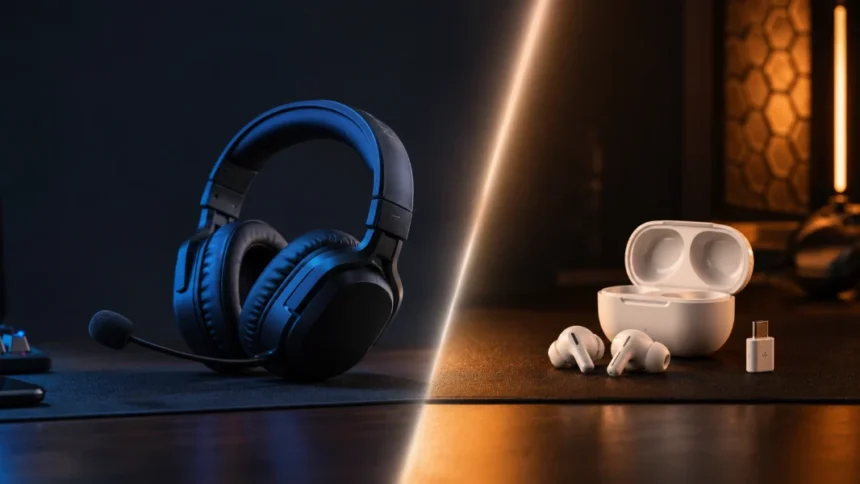

You just finished a four hour session, pulled off your headset, and caught your reflection. Flattened hair, a red groove across the top of your skull, and ears that feel like they have been in a sauna. So you start wondering whether the gaming earbuds vs over ear headsets question finally has a different answer in 2026.
Short version: yes, mostly. Wireless earbuds with a 2.4GHz dongle are now genuinely competitive for ranked play. But the reason is not the one every other article is repeating, and there are two areas where over-ears still win outright. Here is the honest breakdown.
The quick answer (Gaming Earbuds vs Over ear Headsets)
- Buy gaming earbuds if you play on a handheld, commute, wear glasses, overheat easily, or want one device for gaming and daily life.
- Buy an over-ear headset if you live in Discord, play six hour sessions, or your budget is under $100.
- Latency is a solved problem. Any earbud with a proper 2.4GHz dongle lands in the 20 to 40ms range, which is functionally identical to a wireless headset. Plain Bluetooth is still unusable for competitive play at roughly 100 to 300ms.
| Factor | Gaming earbuds (2.4GHz) | Over-ear headset |
|---|---|---|
| Latency | 20 to 40ms | 20 to 40ms |
| Battery per charge | 6 to 12 hours | 40 to 300 hours |
| Mic quality | Usable, inconsistent | Clearly better |
| Comfort at hour four | Ear canal fatigue | Heat, clamp, headband dent |
| Portability | Pocket sized | Needs a bag |
| Entry price | $120 to $200 | $60 to $150 |
What actually changed, and what the internet gets wrong
A lot of 2026 buying guides claim gaming earbuds caught up because the industry moved to xMEMS solid state micro-speakers. That is not what happened, and it is worth correcting because it changes what you should shop for.
xMEMS is real and genuinely impressive. Its Cypress full-range MEMS driver hit mass production readiness in late 2025, with customer shipments starting this year. But it has landed in audiophile and hi-fi TWS products, not gaming earbuds. Open every major gaming in-ear on the market right now, the SteelSeries Arctis GameBuds, Sony INZONE Buds, ASUS ROG Cetra SpeedNova, Razer Hammerhead V3 HyperSpeed, HyperX Cloud MIX Buds 2, and you will find conventional dynamic drivers in all of them.
So what closed the gap? Three unglamorous things:
- Dedicated 2.4GHz dongles that bypass Bluetooth entirely and hit the same latency as a wireless headset.
- Per-game DSP tuning. SteelSeries ships over 100 game specific audio profiles through its app. That software layer does more for footstep audibility than driver size ever did.
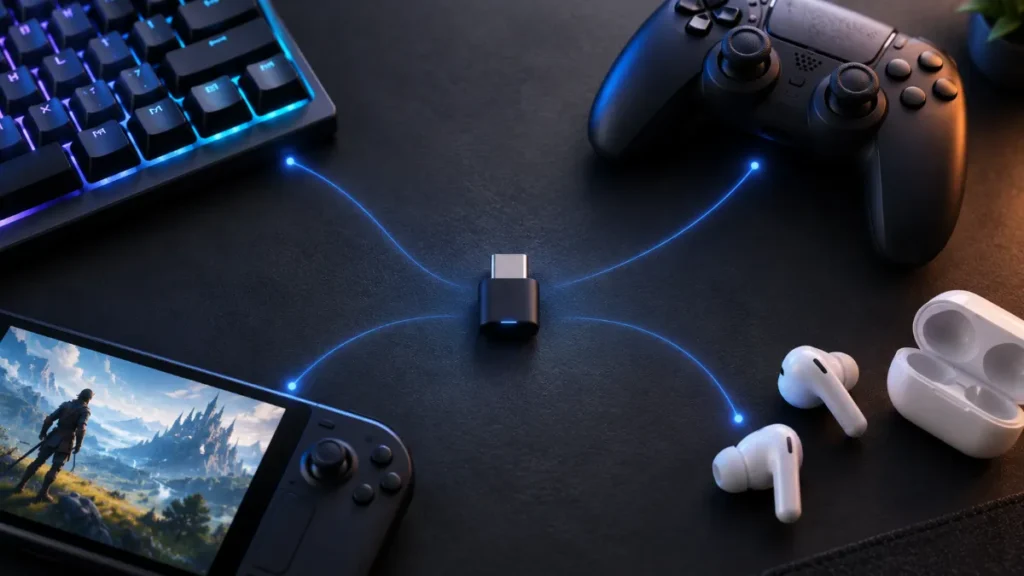
- Platform support. A single dongle now covers PC, PS5, Xbox, Switch, and handhelds, which was the practical blocker for years.
If a review tells you to buy earbuds because of xMEMS drivers, that reviewer has not held the product. Buy based on dongle support and app tuning instead.
Comfort: clamping force vs ear canal fatigue
This is where earbuds win most decisively, but not for free.
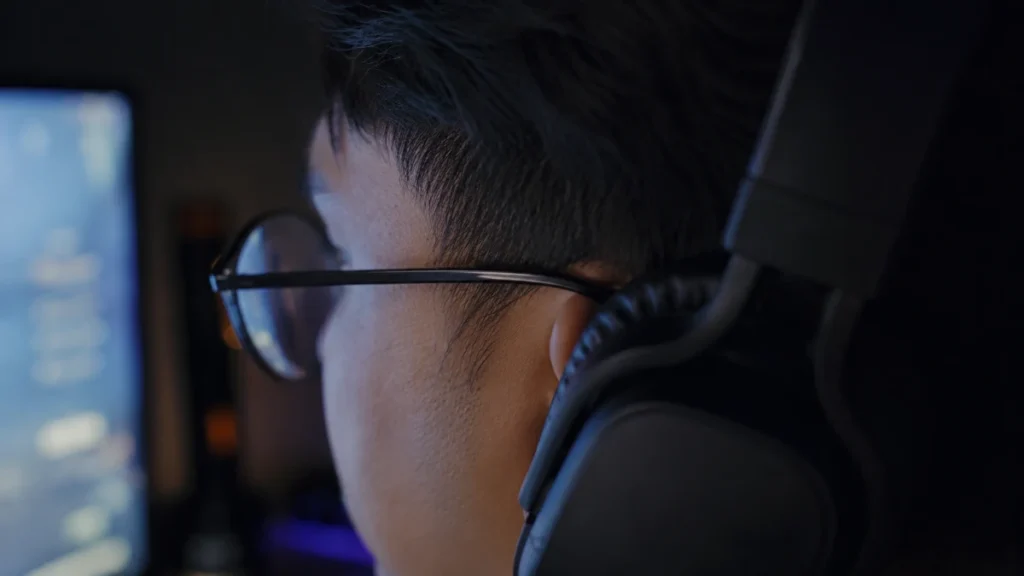
Over-ear headsets rely on clamping force for passive isolation. Sustained pressure on your temples and jaw is what produces the headaches, the hair dent, and the swampy ear feeling after a long session. If you wear glasses, it is worse: the arms press into the side of your head under the earcup, which is a specific misery that in-ears completely sidestep.
Earbuds trade that for a different problem. Silicone tips wedged in your ear canal cause their own ache after three or four hours, and a poor seal wrecks both bass and isolation. Fit is personal, so try the included tip sizes properly rather than defaulting to medium. If sealed tips have never worked for you, open-fit gaming earbuds like the ROG Cetra open wireless design exist specifically for that, at the cost of isolation.
Positional audio: can earbuds handle competitive FPS?
The old wisdom was that you needed 40mm or 50mm drivers for a wide enough soundstage to place enemies. In practice, positional accuracy in a game comes from the engine’s spatial audio and the HRTF processing applied to it, not from driver diameter. Both Sony’s 360 Spatial Sound on the INZONE Buds and SteelSeries’ spatial profiles resolve footstep direction well enough for ranked Valorant, Apex, or Warzone.
If you want numbers rather than impressions, lab measured soundstage and imaging data backs this up across both form factors.
What you actually give up is scale. Explosions, engine noise, and low end rumble feel physically smaller in an in-ear. That matters for a Battlefield or a racing sim and barely matters for a competitive shooter where you have EQ’d everything toward the mid range anyway.
Latency and the platform gotchas nobody mentions
Standard Bluetooth adds roughly 100 to 300ms of delay. That is the difference between hearing a footstep and watching a replay of one. Every serious gaming earbud solves this with a 2.4GHz dongle, dropping latency to around 20 to 40ms.
The catch is the connector. Some dongles are USB-C, which plugs straight into a Steam Deck, a Switch in handheld mode, a PS5 Portal, or a phone. Razer’s Hammerhead V3 HyperSpeed ships a USB-A dongle, so handheld Switch use needs a separate adapter. Check the dongle type before you buy, because it quietly decides whether these work on the device you actually game on most.
Almost all of them also run dual wireless, meaning the dongle handles game audio while Bluetooth stays connected to your phone for calls. That is a real quality of life win over most headsets.
The microphone is still the dealbreaker
If your squad hears you more than they hear the game, keep the headset.
A boom mic sits two inches from your mouth. An earbud mic sits on the side of your head, six inches away, pointed at the room. AI noise filtering has improved fast, and ASUS’ bone conduction mic on the Cetra SpeedNova is the best of the bunch in a noisy room. But reviewers consistently report earbud mics struggling once there is background noise, to the point of switching back to a desktop mic. Your mechanical keyboard will be audible.
One extended hands-on with the Hammerhead V3 ended with the reviewer falling back on a desktop mic entirely. The workaround, if you want earbuds anyway: a cheap standalone USB mic. That combination beats almost any headset boom mic and still keeps your head cool.
Battery: not close
Earbuds get 6 to 12 hours per charge depending on ANC, with the case holding another two to four full top ups. Total figures of 40 to 48 hours are common, but you cannot use it in one sitting. Mid session you are putting a bud back in the case.
Over-ears are in another league. The Razer BlackShark V3 X HyperSpeed runs about 70 hours, and the HyperX Cloud Alpha Wireless advertises 300. If you play in long uninterrupted blocks and hate charging things, that is a genuine argument on its own.
2026 pricing reality check
- Gaming earbuds: $150 to $200 at list price. The SteelSeries Arctis GameBuds sit around $160 to $200, Sony INZONE Buds and ASUS ROG Cetra near $200, Razer Hammerhead HyperSpeed around $150. All of them discount hard, frequently landing $30 to $50 lower, and the GameBuds have dipped under £100 on sale.
- Over-ear headsets: the value zone is $60 to $150, and it is genuinely excellent. The Arctis Nova 5 at around $130 and the Turtle Beach Stealth 500 at the budget end give you most of what a $200 headset does.
You are paying a portability premium of roughly $50 to $70. Never buy gaming earbuds at full list price. They go on sale constantly.
Which one is right for you
Go with earbuds if you split time between a desktop and a Steam Deck, Switch, or PS5 Portal, you wear glasses, your room gets hot, you play in two to three hour blocks, or you want one pair for gaming, the gym, and the commute.
Stick with a headset if you are the shot caller on Discord, you stream, you play marathon sessions, you want deep bass impact in single player games, or your budget stops at $100.
Honestly, many people should own both. A $90 headset for desk sessions plus a $130 sale-priced pair of earbuds for handheld and travel costs about the same as one flagship headset and covers every situation better.
Pros and cons at a glance
Gaming Earbuds (2.4GHz TWS)
| Pros | Cons |
|---|---|
| Far more comfortable if you wear glasses. | Less physical bass impact in cinematic games. |
| No headband dent, no clamping pressure, no sweaty ears. | Ear canal fatigue and fit issues on long sessions. |
| Pocketable and dongle-ready for Steam Deck, Switch, and PS5 Portal. | Costs $50 to $70 more than an equivalent headset. |
| 20 to 40ms latency, matching wireless headsets. | 6 to 12 hours per charge means mid-session case top ups. |
| Dual wireless keeps your phone connected while you game. | Microphones struggle with background noise and keyboard clack. |
Gaming Earbuds (2.4GHz TWS)
| Pros | Cons |
|---|---|
| Boom mics are clearly better for Discord and streaming. | Clamping force causes headaches, heat, and hair dents.Clamping force causes headaches, heat, and hair dents. |
| 70 to 300 hour battery life on a single charge. | Painful over glasses during long sessions. |
| Better value below $100. | Too bulky for handhelds, travel, or public use. |
| Stronger bass presence and physical impact. | Ear pads wear out and need replacing. |
| Nothing sitting inside your ear canal. |
Frequently asked questions
Do gaming earbuds have good spatial audio?
Yes. Positional accuracy comes from the game engine and the HRTF processing in the earbud’s app, not from driver size. Sony’s 360 Spatial Sound and SteelSeries’ game presets both place footsteps accurately enough for ranked play. You lose bass scale, not directional precision.
Are gaming earbuds low latency enough for competitive FPS?
With a 2.4GHz dongle, yes, at roughly 20 to 40ms. Over standard Bluetooth, no, since that runs 100 to 300ms and is clearly noticeable. The connection type matters far more than the brand.
Which gaming earbuds work with Steam Deck and Switch?
Any model with a USB-C dongle plugs directly into a Steam Deck or a Switch in handheld mode. The SteelSeries Arctis GameBuds, HyperX Cloud MIX Buds 2, and Sony INZONE Buds all work this way. Razer’s USB-A dongle needs an adapter for handheld use.
Is the earbud microphone good enough for Discord?
Good enough for casual squad chat in a quiet room. Not good enough if you call shots competitively or stream. Background noise is the weak point. Pairing earbuds with a cheap USB desk mic solves it entirely.
Do any gaming earbuds use xMEMS drivers yet?
Not as of 2026. xMEMS Cypress reached mass production readiness in late 2025 and is shipping into hi-fi and audiophile TWS products, but every major gaming earbud still uses conventional dynamic drivers. Treat xMEMS as a technology to watch, not a spec to shop for.
How do I stop getting a hair dent from my headset?
You cannot fully, because passive isolation depends on clamping pressure. You can reduce it by loosening the headband adjustment, choosing a suspension or ski band design, or picking a headset under 280g. Switching to in-ears is the only way to eliminate it.
The verdict
2026 is the first year you can genuinely swap to earbuds without giving up your competitive edge. The 2.4GHz dongle solved the only problem that mattered, and per-game audio profiles closed the rest of the gap. If you are mobile, run hot, or wear glasses, make the switch and stop suffering for no reason.
But if you basically live in a Discord call and measure sessions in half days, the over-ear headset is still the correct tool. Better mic, vastly better battery, better price. It is not retiring anytime soon, and there is nothing wrong with owning one of each.
Also see: PS5 Emulator Guide for PC