

Anthropic‘s headline pitch for Claude Sonnet 5 is simple: near-Opus intelligence at a fraction of the price. But if you run the actual token math, that “discount” starts looking less generous than the press release suggests — a detail almost every launch-day article skipped over. In fact, Anthropic’s own documentation quietly confirms it.
The Real Claude Sonnet 5 Cost vs. The Marketing Numbers
Anthropic launched Claude Sonnet 5 on June 30, 2026, and advertises the Claude Sonnet 5 cost at $2 per million input tokens and $10 per million output tokens through August 31, 2026, reverting to $3/$15 afterward — the exact same sticker price as Sonnet 4.6. On paper, the intro rate beats Opus 4.8 outright. You can verify the full rate card in Anthropic’s official pricing documentation.
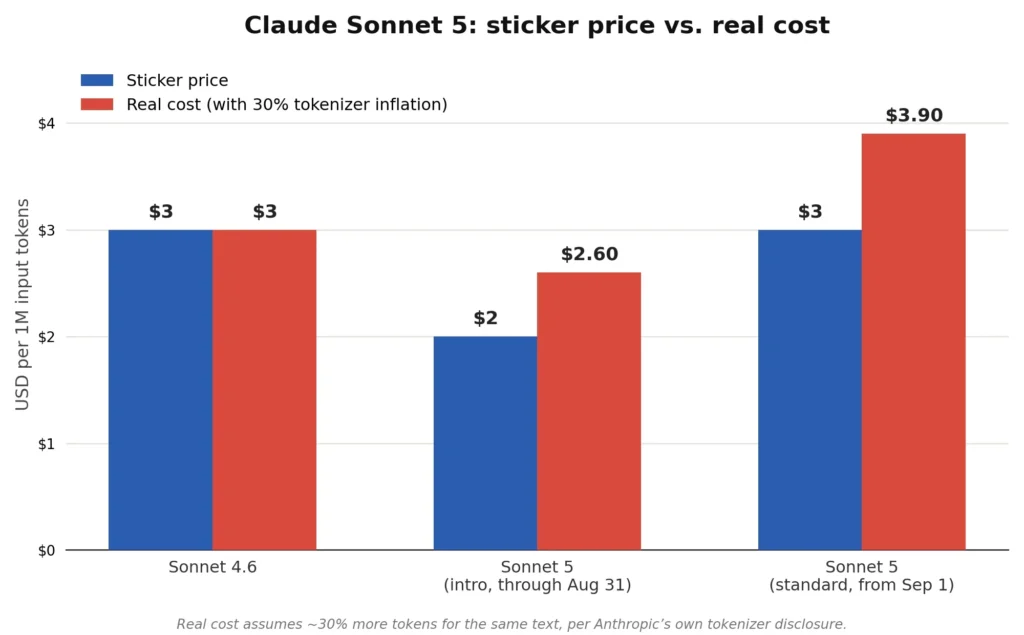
But there is a catch, and it comes straight from the source. Anthropic’s own “What’s new in Claude Sonnet 5” developer docs state that the model ships with a new tokenizer that produces approximately 30% more tokens for the exact same input text compared to Sonnet 4.6. Since you pay per token — not per word — that is a price increase disguised as a discount. Anthropic even described the intro pricing as making the migration “roughly cost-neutral” versus Sonnet 4.6, which is the vendor’s own admission that the headline rate is not a real cut.
Independent Tests: The Tax Depends on Your Language
Developer Simon Willison measured the new tokenizer against real documents on launch day, and his numbers show the “roughly 30%” figure hides a wide spread. According to Willison’s independent tokenizer analysis, English text inflates by roughly 1.4x, Spanish by about 1.33x, Python code by around 1.28x — while Simplified Chinese is essentially unchanged. If your workload is English-heavy content or code, you sit at the expensive end of the range. If it is Chinese, the tokenizer tax barely touches you.
Running the Numbers on a Real Workload
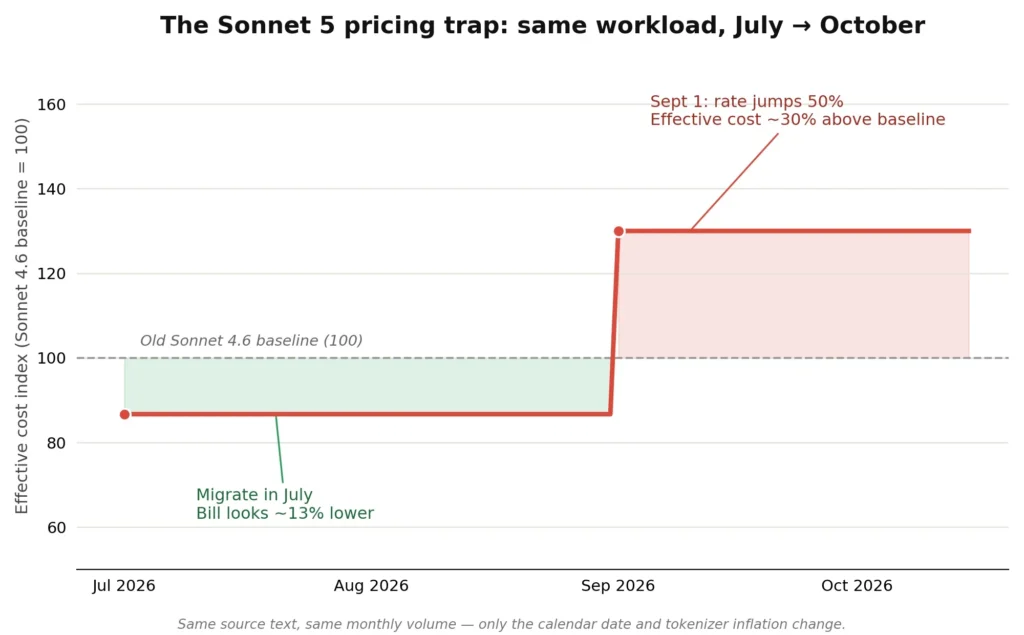
For an agency processing high volumes of code review or content generation, the tokenizer change alone erodes a meaningful chunk of the advertised savings. Cost-engineering audits — such as Finout’s detailed Sonnet 5 pricing analysis — traced the trap in the curve: migrate in July and your bill drops, so finance sees a win and nobody flags it. Then on September 1 the per-token rate jumps 50% on identical traffic, and because the tokenizer is already inflating your counts, the effective cost can land 20–35% above your old Sonnet 4.6 baseline — while the rate card still reads $3/$15, the “same” price as before.
| Cost Factor | What Anthropic Highlights | What Actually Happens |
| Input Price | $2/M Tokens (Intro) | ~30% more tokens billed per identical input (up to 1.4x for English) |
| Output Price | $10/M Tokens (Intro) | Adaptive thinking defaults to high effort, generating far more billed output tokens |
| Net Effect | “Cheaper AI” | Roughly cost-neutral now; 20–35% above baseline after Sept 1 |
| Best Case | Major savings vs. Opus 4.8 | Savings appear primarily when downgrading from Opus ($5/$25) |
Where the Savings Story Actually Holds Up
The discount narrative is genuinely true in one specific scenario: teams currently running heavy workloads on Opus 4.8, which is priced at $5/$25 per million tokens. Switching an Opus-tier workload to Sonnet 5 cuts API spend by roughly 40% at standard rates and up to 60% during the intro window, even after accounting for the tokenizer change — and per Anthropic’s own launch announcement, Sonnet 5’s performance is close to Opus 4.8 on agentic coding and tool use. That is a real, defensible number. But it is a different claim than “Sonnet 5 is cheaper than Sonnet 4.6,” which is the comparison most of the marketing implies.
What This Means Before You Migrate
Before locking in your Claude Sonnet 5 cost projections, keep these steps in mind:
- Stress-Test, Don’t Guess: Run a 48-hour parallel test. Send identical production traffic to Sonnet 4.6 and Sonnet 5 and measure the actual
usage.input_tokensdelta on your own content mix — code and structured payloads sit at the high end of the inflation range. - Recalculate Budget Constraints: Since the new tokenizer is more verbose, your
max_tokenslimits and context-window budgets fill up faster. Anthropic’s migration notes recommend recounting prompts before switching. - Re-Warm Your Caches: New tokenizer boundaries invalidate existing prompt-cache entries on first run. Prompt caching and the Batch API remain the best ways to claw back the tokenizer penalty.
- Prepare for the September Cliff: The $2/$10 intro rate ends August 31, 2026. Budget at the standard $3/$15 rate — a 50% jump — with your measured tokenizer inflation baked in, before you make Sonnet 5 your permanent default.
Sonnet 5 is a genuinely powerful model — the benchmark gains over Sonnet 4.6 are real. But the “cheaper AI” framing is doing more work than the actual invoice math supports, and Anthropic’s own “roughly cost-neutral” language is the closest thing to a confession you’ll get from a pricing page.
How much does Claude Sonnet 5 cost?
Through August 31, 2026: $2 per 1M input tokens / $10 per 1M output tokens.
Starting September 1, 2026: $3 per 1M input tokens / $15 per 1M output tokens — the same sticker price as Sonnet 4.6.
Why are my Sonnet 5 bills higher than expected?
Sonnet 5 uses a new tokenizer that generates roughly 30% more tokens for the exact same text compared to Sonnet 4.6 — up to 1.4x for English content, per independent testing. Since you are billed per token, this “tokenizer tax” eats into the advertised savings.
Is Sonnet 5 actually cheaper than Claude Opus?
Yes. Opus 4.8 costs $5/$25 per million tokens. Migrating an Opus 4.8 workload to Sonnet 5 cuts API spend by roughly 40% at standard rates — up to 60% during the intro window — even after accounting for the new tokenizer.
Does the new tokenizer affect context windows?
Yes. Because the same text uses roughly 30% more tokens, your context limits and max_tokens budgets fill up faster. Sonnet 5 does ship with a 1M-token context window by default, which offsets this — but recount your prompts before migrating to avoid truncation.
Does the tokenizer tax affect all languages equally?
No. Independent measurements found English inflates by roughly 1.4x, Spanish ~1.33x, and Python code ~1.28x, while Simplified Chinese is essentially unchanged. Chinese-language workloads get a genuine discount; English-heavy workloads mostly do not.