
Roblox has spent twenty years telling people that anyone can make a game. On July 16, 2026, it finally removed the last excuse. Roblox AI Build is a new tab inside the Roblox mobile app that takes a plain-English sentence and hands back a playable 3D game. No Studio install. No Luau. No 3D modelling software. Just a prompt and a few seconds of waiting.
The public alpha opens today, July 28, 2026 but only in New Zealand, and only for age-checked users aged nine and up.
That gap between the pitch and the rollout is the whole story. Here is what Build genuinely does, what it does not, and why the people who should be most excited about it are the ones sounding the alarm
Roblox AI Build at a Glance
| Detail | What We Know |
| Announced | July 16, 2026 |
| Public Alpha | July 28, 2026 |
| Region | New Zealand only, wider rollout “over the coming months” |
| Minimum Age | 9+ (age-checked) to create; 16+ to publish globally |
| Platform | Roblox mobile app, new “Build” tab |
| Price | Free base tier, paid features planned for power users |
| Underlying Tech | Mix of open-source models and Roblox’s own Cube foundation model |
5 Things Roblox AI Build Can Actually Do
1. Turn One Sentence Into a Playable Starting Point
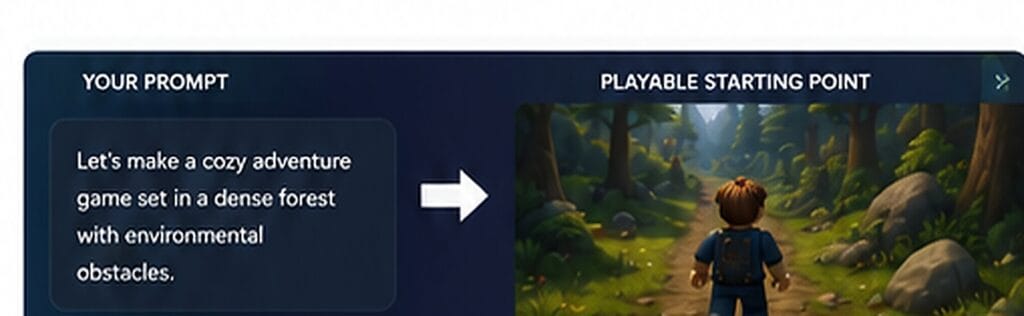
The headline capability, and the one Roblox demoed itself. Type something like
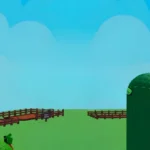
prompt: “let’s make a cozy adventure game set in a dense forest with environmental obstacles,”
and Build assembles a first draftgameplay mechanics, environment, characters, visual style and soundthat you can immediately walk around in.
It is a starting point, not a finished game. Roblox is careful about that word, and so should anyone reviewing the tool. What you get is closer to a rough level blockout with working rules than a shippable experience. Check out our active list of Roblox game codes to see what full, polished experiences look like on the platform.
2. Hand the Same Project Off to Desktop Roblox Studio
This is the part most coverage skipped, and it is the most important detail in the announcement. Build is not a separate toy app with its own file format. It shares a back end with Roblox Studio.
Practically: you can sketch a mechanic on your phone on the bus, then open the exact same project on a PC that evening and hand-write Luau against it. You can also kick off an agent from Studio and check its progress from your phone. Most text-to-3D experiments die because the output is a dead-end export. Build’s output is a live Roblox project from the first second.
3. Generate Objects That Behaved, Not Just Objects That Sit There
Build inherits Roblox’s Cube foundation model, which the company open-sourced a version of back in March 2025. Cube handles text-to-3D-mesh generation but the interesting layer sits on top of it.
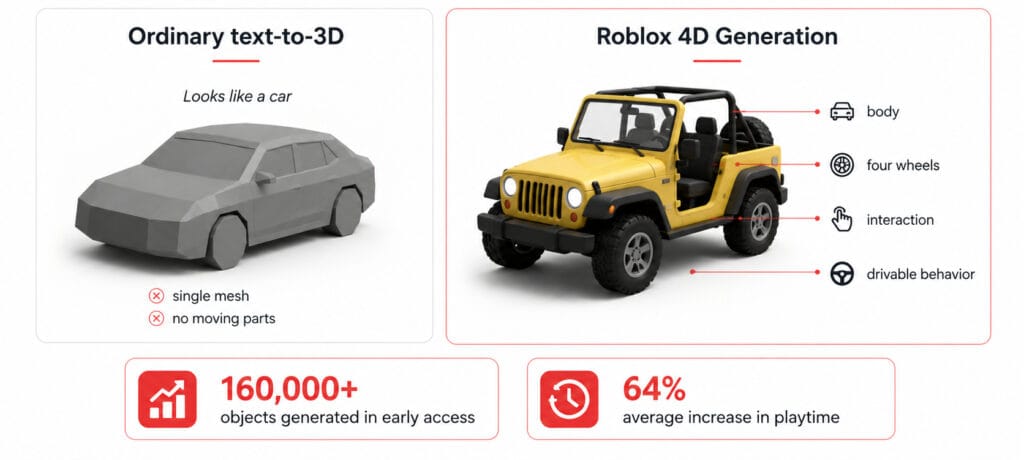
In February 2026, Roblox pushed 4D generation into public beta. The “fourth dimension” here is interactivity. Instead of producing a hollow car-shaped mesh, the system uses structural schemas Roblox launched with Car-5 (a body plus four independently addressable wheels) and Body-1 (any single-mesh object) so the generated car has moving parts and can actually be driven.
Roblox reported that players generated over 160,000 objects with 4D during early access inside the experience Wish Master, and that players who used 4D generation averaged a 64% increase in play time there. That is the number to watch. It suggests generation itself is the entertainment, not just a means to an end
4. Run Agents That Test and Analyse Your Game for You
Alongside Build, Roblox is shipping a set of agents for creators over the coming months:
- A playtesting agent that hunts bugs before players run into them.
- An analytics agent that answers plain-language questions about how a game is performing, instead of making you build dashboards.
- An experiment agent that proposes tests to lift engagement and monetisation.
For a solo creator, the analytics agent may matter more than Build itself. Prototyping was never the hard part of Roblox development. Understanding why a game bleeds players at the thirty-second mark was
5. Eventually, Generate Whole Scenes From One Prompt
Roblox has confirmed a scene-generation model in development, capable of producing entire editable and playable 3D environments from a single text prompt. This is not shipped. Treat it as roadmap, not feature.
Roblox is unusually blunt about the obvious risk. In its own announcement, the company said its discovery systems are built to surface games with long-term retention and that AI slop does not qualify. It added that if nobody plays a game, nobody can find it.
That is a real argument, not just PR. Roblox’s homepage has never been a chronological feed; it is a retention-ranked feed. A prompted game that cannot hold a player past the first thirty seconds does not “flood” anything, because it never surfaces in the first place. The catalogue gets bigger; the visible catalogue does not necessarily get worse.
The counterargument is scale. Roblox already hosts tens of millions of experiences competing for attention. Moderating live, generated 3D content at scale is a genuinely unsolved problem, and it is unsolved on a platform where a large share of users are children.
The staged rollout one country, age-checked, 16+ to publish globally reads less like caution theatre and more like a company that knows exactly how bad a bad week could be.
There is precedent worth watching. We have already seen issues with AI content flooding app stores: Apple saw an 84% jump in App Store submissions and moved to crack down on low-quality AI-built apps. Roblox is betting its ranking algorithm handles what Apple had to handle with policy
What This Does to the Roblox Freelance Economy
Commissioning a mid-tier Roblox experience has traditionally meant hiring 3D builders and Luau scripters, typically in the $40–$70 per hour range, with competitive studio-quality projects running well into five figures.
| Creation Metric | Traditional Roblox Studio | Roblox AI Build |
| Upfront cost | $1,000–$10,000+ in freelance rates | $0 on the free tier |
| Time to first prototype | 2–6 weeks | Seconds |
| Required skill | Luau scripting, 3D modelling | Writing a clear sentence |
| Available to | Experienced developers | Age-checked NZ users, 9+ (alpha) |
That last row matters and gets misreported constantly. Roblox averaged 132 million daily active users in Q1 2026 but that is the platform’s audience, not Build’s. Build’s addressable user base today is a single country in alpha. The 132 million figure is the ceiling, not the launch.
The free tier is not charity, either. Roblox needs volume to learn what people prompt for and which generated games retain. Power users will hit caps on advanced logic generation, asset limits and deeper agent access, and that is where the paid tiers arrive.
The Market Is Not Buying It Yet
Here is where most coverage of Build gets the finance wrong.
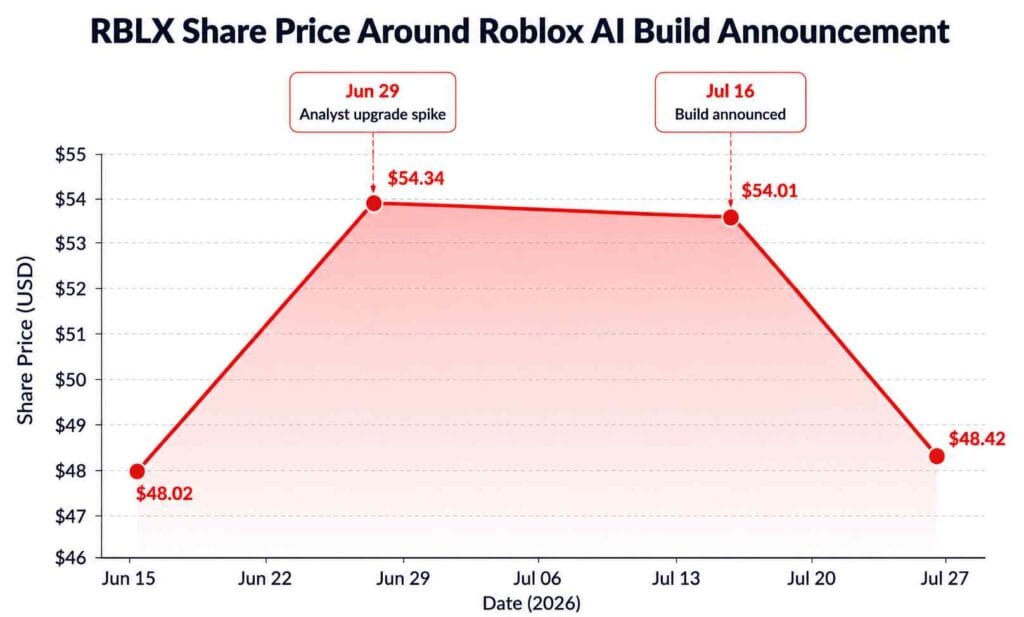
RBLX did climb through late June and early July 2026, roughly from the $48 range to around $54. But that move traces most cleanly to an analyst upgrade on June 29 that sent shares up more than 12% in a session not to a Build announcement that had not happened yet.
More importantly, the move is gone. Roblox closed at $48.42 on July 27, 2026, right back where the run started, and the stock is down roughly 51% over the trailing twelve months against a 52-week range of $40.15 to $150.59.
The pressure is not about AI. It is about age verification. The rollout restricted on-platform communication for non-age-checked users, hit sign-ups and bookings harder than management expected, forced a full-year guidance cut, and has already drawn a securities fraud suit filed after an 18% single-move drawdown.
Which sets up the real near-term catalyst: Roblox reports Q2 2026 on July 30, with analysts modelling roughly $1.59 billion in revenue and a loss near $0.34 per share. Build is a 2027 story at the earliest. Whether the age-check drag is easing is a Thursday story.
Why Roblox’s Moat Is Distribution, Not Model Quality
Zero-code game creation is the central front of the 2026 generative AI race, and Roblox is not the technical leader.
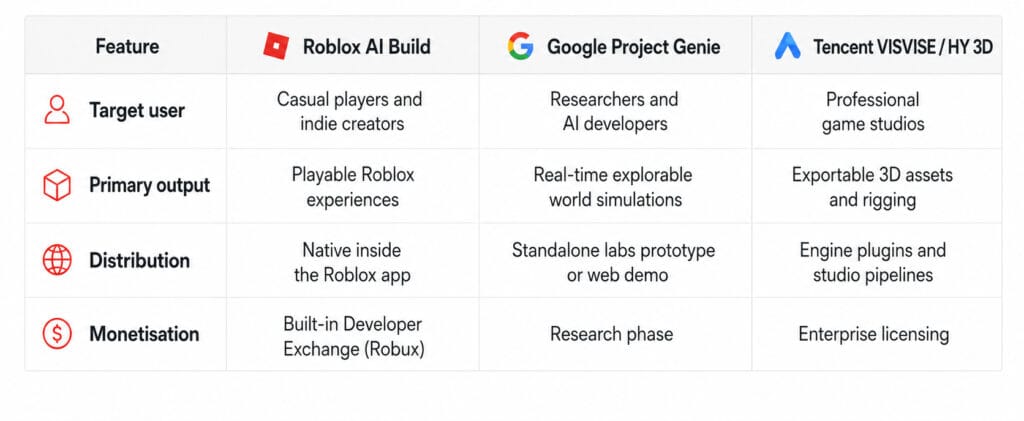
Like Google’s Project Genie, launched to AI Ultra subscribers in January 2026 and powered by Genie 3, systems can now generate photorealistic explorable worlds in real time at 720p and 24fps. On raw generation quality, Genie is arguably ahead of anything Roblox ships. It also launched with conspicuously few guardrails around copyrighted material reporters were able to produce playable scenes closely resembling Super Mario 64 and Breath of the Wild, which is precisely the kind of exposure a platform hosting millions of minors cannot take on.
Tencent, meanwhile, brought VISVISE to GDC in March 2026, built on its HY 3D multimodal foundation model, with automated retopology and LOD generation a genuinely strong professional pipeline aimed at studios.
Both are building tools for developers. Roblox is shipping creation to consumers who never export a file, never configure an engine, and can monetise inside the same app they built in. Prompt, build, publish, get paid one surface. That vertical integration is the moat. Model parameters are not.
The Scarce Resource Is Changing
When the technical floor for making a game hits zero, programming ability stops being the bottleneck. What is left is knowing what is worth making and having the judgement to tell a prompt that produces something people replay from one that produces something they close in twenty seconds.
Roblox’s retention-ranked feed does not care how a game was made. It only cares whether anyone stays. That was already true before Build. It is just about to become the only thing that is true.
Is the Roblox AI Build feature free?
Yes. There is a free base tier on the Roblox app. Roblox has said paid options will arrive for power users, covering things like advanced logic generation, larger scene limits and deeper access to the creator agents
When does the Roblox AI Build feature launch?
The public alpha begins July 28, 2026, in New Zealand, for age-checked users aged nine and older. Roblox says it will expand to more creators and regions over the coming months
Can I publish a game made with Roblox Build?
You can share creations with friends at any eligible age, but publishing to Roblox’s global platform requires being age-verified and at least 16