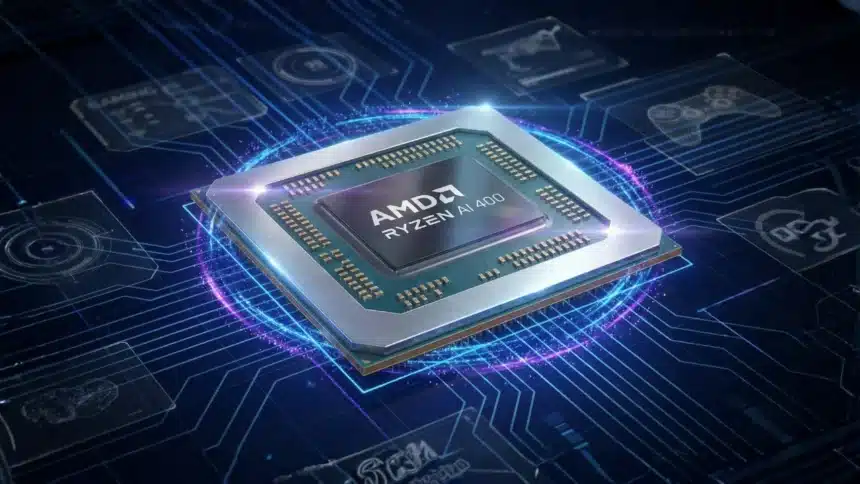

AMD drops AMD Ryzen AI 400 Series and Ryzen 7 9850X3D at CES 2026. There’s 250+ AI PC platforms now run AMD silicon, doubling last year’s count. Intel trails in Artificial Intelligence speed and gaming frames during the Windows Copilot+ surge. These chips pack 60 TOPS NPUs and 5.6GHz boosts for real workloads. Builders and gamers get upgrades that actually deliver, stick around for the breakdowns.
Core Specs Breakdown
AMD Ryzen AI 400 Series packs 12 CPU cores and 24 threads in top models like Ryzen AI 9 HX 470. Boost clocks hits 5.25GHz+ with Radeon 890M graphics (16 CUs, 1024 shaders). NPU delivers up to 60 TOPS in flagships for local AI. Ryzen 7 9850X3D sticks to 8 Zen, 5 cores/16 threads but ups boost to 5.6GHz from 9800X3D’s 5.2GHz. 104MB cache (96MB L3 3D V-Cache) stays, TDP holds at 120W which supports full overclocking via PBO and Curve Optimizer.

Redstone ray tracing, this is part of the new FSR ecosystem designed to work with the 60 TOPS NPU on the Ryzen AI 400 series that simulates light without frame drops. Laptops claim 24-hour battery on Ryzen AI 7 445. Q1 2026 rollout hits laptops, mini-PCs, desktops.
You May Also Like: Is Gigabyte G6 KF the Gaming Beast or Just Hype? Review
AMD Ryzen AI 400 Push Against Intel
This follows Ryzen AI 300’s 2024 launch, where AMD grabbed Artificial Intelligence PC lead over Intel Lunar Lake. Ryzen AI 400 refreshes Strix Point with higher clocks, memory bandwidth, 60 TOPS NPU vs Lunar Lake’s ~48 TOPS. AMD claims 10% edge over Intel Core 9288V at 30W.
In content apps, Ryzen AI 400 runs 1.7x faster than rivals. Multitasking jumps 1.3x. Powering these content creation wins is the new Ryzen AI Max+ (formerly codenamed Strix Halo). Teased as a workstation-class beast, this chip bridges the gap between traditional laptops and desktops. It features up to 40 GPU Compute Units (CUs) and supports a massive 128GB of unified memory, directly targeting creators who would usually need a MacBook Pro or a bulky laptop with a dedicated GPU. Gaming iGPU uses AMDSR for upscaling from low-res sources.
“The performance delta is going to be relatively small in triple-A games, but if you look at esports titles that require high frequencies… you’re going to see a 5% or more performance uplift.”
David McAfee (VP & GM of Ryzen)
Gaming Focus Sharpens
Ryzen 7 9850X3D targets esports with 7% average gain over 9800X3D, up to 15% in frequency-sensitive titles. Beats Intel Core 9285K and even 14900K in games. Second-gen 3D V-Cache sits under die for better cooling. 96MB L3 cache excels in cache-heavy games. AM5 socket compatible; no arch changes, just binning tweaks. Pricing eyes $499-$511 MSRP, near 9800X3D’s $479.
| Processor | Cores/Threads | Boost Clock | Cache | TDP | Gaming Edge |
|---|---|---|---|---|---|
| Ryzen 7 9850X3D | 8/16 | 5.6GHz | 104MB | 120W | 7% vs 9800X3D |
| Ryzen 7 9800X3D | 8/16 | 5.2GHz | 104MB | 120W | Baseline |
| Intel Core 9285K | Varies | Varies | Varies | Varies | Trails in frames |
You May Also Like: GTA 5 PC Requirements (2025): Minimum, Recommended & Enhanced Specs Explained
Competitor Head-to-Head
AMD Ryzen AI 400 outpaces Intel Lunar Lake by 27% in LLMs, lower latency in Llama 3.2 (50.7 vs 39.9 tokens/sec). Total platform ~80+ TOPS crushes Lunar Lake’s 120 TOPS claim in real tests.
Vs Qualcomm Snapdragon X Elite (45 TOPS), AMD wins multi-core. iGPU edges Intel Arc in Vulkan AI accel. Rahul Tikoo, AMD client GM, notes 2x platform growth to fend off Intel Core Ultra 3 series.
| AI Metric | Ryzen AI 400 | Intel Lunar Lake | Snapdragon X |
|---|---|---|---|
| NPU TOPS | Up to 60 | ~48 | 45 |
| Multitasking | 1.3x rivals | Baseline | Varies |
| Content Creation | 1.7x rivals | Trails | Trails |
“We aimed for leadership performance across the CPU, the GPU, and the NPU… enabling the next wave of experiences with multi-day mobility.”
Rahul Tikoo (Senior VP, AMD Client Business)
Risks Exposed
No pricing yet for Ryzen AI 400 systems, expect premium over $1000 laptops. Battery claims lack independent tests vs Lunar Lake’s efficiency focus. NPU hype ties to Windows Copilot+ mandates, locking out non-compliant rigs. Availability hinges on OEMs like Lenovo and HP. Gaming chip co-exists with 9800X3D, splitting stock. Local Artificial Intelligence runs drain battery faster in heavy LLM use without cloud fallback.
AI PC shift demands app devs optimize for AMD NPUs, or gains evaporate. Intel’s 18A node looms for Panther Lake counter. AMD bets on volume, but Nvidia dominates accelerators at 75% market share. OEMs integrate these by Q1: gamers grab 9850X3D for AM5 upgrades. Artificial Intelligence tasks shift local, cutting cloud costs if software follows. Intel scrambles as AMD stacks 250+ platforms.
Also Read: Cloud Gaming 2026 Guide: Play AAA PC Games on Android & Low-End Laptops (Free & Paid)