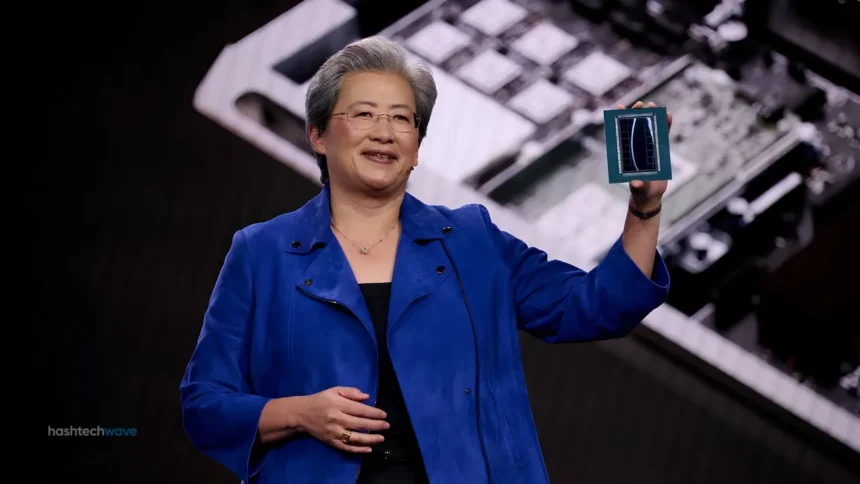

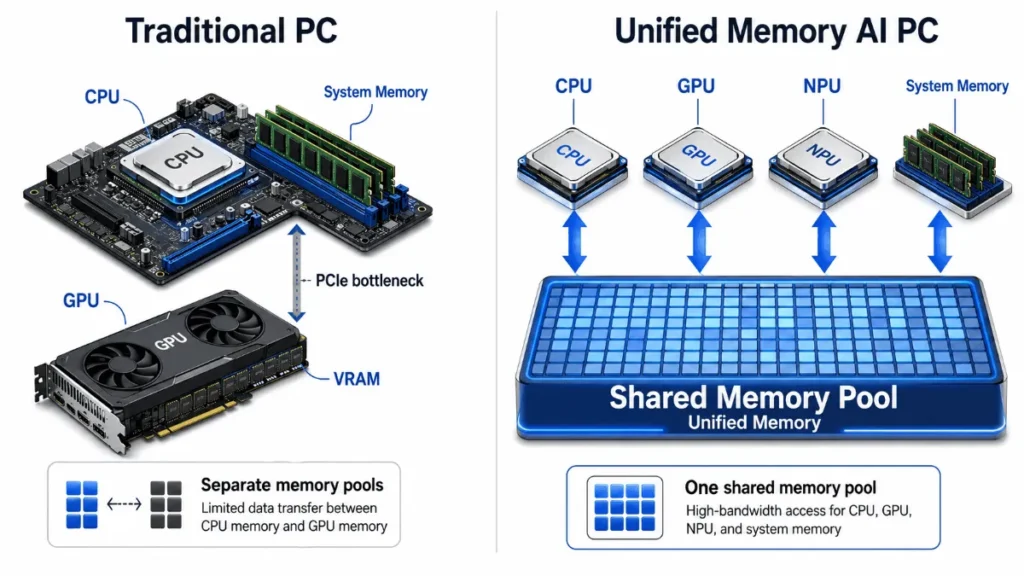
AMD’s Ryzen AI Max+ 395 — codename Strix Halo broke that wall by borrowing Apple’s playbook: a unified pool of up to 128GB of LPDDR5X memory shared between a 16-core Zen 5 CPU, a 40-CU Radeon 8060S iGPU, and an XDNA 2 NPU, all on one package. A year and a half after launch, there’s now enough real-world benchmark data from llama.cpp maintainers, independent labs, and owners running these boxes daily to answer the question that actually matters:
For years, running large language models at home meant one thing: the VRAM wall. Consumer GPUs topped out at 24GB (RTX 4090) and now 32GB (RTX 5090) — enough for a quantized 30B model, nowhere near enough for the 70B and 120B-class models where local AI gets genuinely interesting.
Should you buy a Strix Halo machine for local AI in 2026 or spend your money somewhere else?
This guide synthesizes published benchmarks and owner reports (sources linked throughout) rather than a single lab test, so you can see where the numbers agree and where they don’t.
What Strix Halo Actually Is (and the One Number That Matters)
On paper, the Ryzen AI Max+ 395 is a monster APU: 16 Zen 5 cores using the same CCDs as desktop Ryzen 9000 chips, a Radeon 8060S iGPU with 40 RDNA 3.5 compute units, and a 50-TOPS NPU. But for LLM work, one specification decides everything: the 256-bit LPDDR5X-8000 memory bus.
That bus delivers up to 256 GB/s of theoretical bandwidth with real-world testing landing around 212–215 GB/s. Here’s why that’s the whole story:
Generating a token requires streaming the entire model’s weights through memory. Every single token. So token generation speed is almost purely a function of memory bandwidth divided by model size. A 40GB quantized 70B model on a ~215 GB/s pipe gives you roughly 5 tokens per second and that’s exactly what owners measure.
The 128GB capacity is what lets the model fit. The 256-bit bus is what makes it usable. This is also why the soldered RAM isn’t a cost-cutting move: socketed DDR5 physically can’t support a bus this wide. You’re buying into the memory architecture, and it’s a deliberate one.
Real-World Performance: Tokens Per Second by Model Size
| 7–14B (Q4–Q8) | Llama 3 8B, Qwen 14B | 30–60+ tok/s | Instant, faster than you read |
| 27–32B (Q4–Q6) | Gemma 27B, Qwen 32B | 12–25 tok/s | Smooth interactive chat |
| 70B dense (Q4–Q8) | Llama 3.3 70B | ~5–15 tok/s (quant-dependent) | Usable; noticeable pauses at higher quants |
| 100B+ MoE (4-bit) | GPT-OSS 120B MXFP4 | ~34 tok/s | The surprise sweet spot |
Two takeaways matter more than any single number.
First, Mixture-of-Experts models are where this hardware shines. A 120B-class MoE model only activates a fraction of its weights per token, so it streams far less data per token than a dense 70B — which is why GPT-OSS 120B runs at ~34 tok/s while dense Llama 70B crawls by comparison. If your 2026 workflow is built on MoE models (and increasingly, it should be), Strix Halo punches far above its bandwidth.
Second, quantization is your throttle. The same 70B model spans roughly 5 tok/s at Q8 to ~15 tok/s at aggressive 4-bit quants. The community’s rule of thumb is that 3–5 tok/s is the floor for tolerable conversation — Strix Halo clears it at every quant level, but only just at high precision.
The Prompt-Processing Problem Nobody Mentions
Here’s the caveat that launch coverage skipped and owners discovered fast: LLM inference has two phases with opposite hardware demands.
- Prefill (reading your prompt) is compute-bound — raw parallel math throughput.
- Decode (writing the answer) is memory-bandwidth-bound — the weight-streaming problem above.
Strix Halo has server-class memory capacity but iGPU-class compute. So while its decode speed nearly ties NVIDIA’s dedicated AI boxes, its prefill is dramatically slower. On the GPT-OSS 120B benchmark, Strix Halo processes prompts at roughly 340 tok/s versus the DGX Spark’s ~1,700 tok/s — about a 5× gap. The Register’s independent lab test found the same pattern: 2–3× slower time-to-first-token on short prompts, widening on long ones.
The Apple M3 Ultra Comparison
You can’t discuss unified memory without looking at Apple. For the last few years, the Mac Studio has been the default choice for developers needing high-capacity memory for large language models, supporting up to 512GB of unified memory on the M3 Ultra.

While Apple’s flagship pushes an astonishing 819GB/s of memory bandwidth, AMD’s 128GB solution brings this Mac-like architecture into the x86, Linux, and Windows ecosystems. For engineers who demand an open software environment and hardware-level sovereignty outside of macOS, the Strix Halo provides a much-needed, cost-effective alternative.
Strix Halo vs Everything Else in 2026
| Feature | Strix Halo (128GB) | NVIDIA DGX Spark | Mac Studio M4 Max (128GB) | 3× used RTX 3090 rig | RTX 5090 |
|---|---|---|---|---|---|
| Price | ~$1,500–$2,500 | $4,699 (raised from $3,999 in Feb 2026) | $1,999–$5,999 | ~$2,100–$3,000 used | $2,000+ (card alone) |
| Usable AI Memory | up to ~96–110GB | 128GB | up to 128GB | 72GB pooled | 32GB |
| Memory Bandwidth | ~215 GB/s measured | ~273 GB/s | ~546 GB/s | ~936 GB/s per card | ~1.8 TB/s |
| 120B MoE token gen | ~34 tok/s | ~38 tok/s | faster (bandwidth) | ~124 tok/s | won’t fit |
| Prompt processing | weak (~340 tok/s) | excellent (~1,700 tok/s) | good | excellent | excellent |
| Software | ROCm/Vulkan (improving) | CUDA (reference platform) | MLX (mature, macOS-only) | CUDA | CUDA |
| Form factor | silent mini-PC / laptop | 1L appliance, audible | near-silent desktop | loud multi-GPU tower, ~1kW | needs full desktop |
| Best for | cheapest 70B+ capable box | CUDA devs, long-context work | macOS users, quiet + fast | max tokens/dollar, tinkerers | fast small models |
The honest reading of that table:
- The DGX Spark is not 3× better for being 3× the price. Token generation is a near-tie (~34 vs ~38 tok/s on 120B). You’re paying the premium for CUDA compatibility and prompt-processing speed — real advantages, but only for specific workloads. It also runs ARM64, which brings its own binary-compatibility friction. And its price has climbed 56% since the CES 2025 announcement.
- A used 3× RTX 3090 rig still wins raw tokens per dollar — over 3× the generation speed of either appliance. The cost is noise, ~1kW of power draw, and a weekend of PCIe archaeology. It’s a rig, not an appliance.
- The Mac Studio M4 Max is the bandwidth king of unified memory (~546 GB/s) if you live in macOS and can stomach Apple’s RAM pricing at the top configs.
- The RTX 5090’s 32GB raised the consumer ceiling but didn’t remove it. It’s the fastest option for models that fit — and irrelevant for the 70B+ class this whole category exists for.
Which Strix Halo Machine Should You Buy?
The chip ships in very different bodies. As of mid-2026:
- GMKtec EVO-X2 — the value pick. A paperback-sized mini-PC starting around $1,499 (64GB tier) with 128GB configurations above that. Early units had BIOS issues that didn’t expose the full memory bus; GMKtec’s 2025 update cadence fixed the worst of it, and current units hit the bandwidth the silicon promises. Cheapest ticket into 70B-class local inference, period.
- Framework Desktop — the enthusiast pick. ~$1,599 as commonly configured (64GB; 128GB available). A charming 4.5L box with real community support and the most documentation of any Strix Halo machine. Know that it’s less upgradeable than Framework’s laptops — the RAM is soldered because the memory bus demands it — and some owners report USB4/multi-monitor quirks under Linux.
- Corsair AI Workstation 300 — the thermal pick. A larger chassis with cooling headroom that matters: the tiny mini-PCs throttle under sustained multi-hour inference loads, and this one doesn’t. Owner-reported 12–15 tok/s on quantized 70B models reflects the sustained-load advantage.
- HP ZBook Ultra G1a — the laptop. The 128GB Strix Halo in a 14″ workstation body. This is the unit Phoronix used to show the chip runs faster on Linux than Windows 11 — worth knowing before you pick an OS.
- AMD Ryzen AI Halo reference box — the DGX Spark rival. Launched mid-2026 at $3,999 explicitly against NVIDIA’s appliance, with ROCm 7.2.x and day-0 model support out of the box. Undercuts the Spark by $700, but at that price the used-3090-rig math gets loud.
The Software Reality: ROCm, Vulkan, and the “Debug Tax”
Buying AMD for AI still means paying a debug tax. Here’s its actual 2026 shape:
The dual-backend workflow is the norm. Most owners run llama.cpp with the Vulkan backend for everyday use — it’s the path of least resistance — and switch to ROCm when they need long-context performance. The reason: Vulkan performance degrades noticeably past ~4K tokens of context, while ROCm with Flash Attention stays flat past 8K. Building RAG pipelines? ROCm is worth the setup pain.
Linux is the fast path. ROCm 7.x on a recent Fedora or Ubuntu with current Mesa drivers is where the platform performs. It works on Windows, but trails in maturity — and benchmarks show the chip itself is simply faster under Linux.
Ollama and LM Studio abstract most of the pain for straightforward chat use. The friction lives at the edges: CUDA-only GitHub repos, research code with hard torch.cuda assumptions, fine-tuning workflows. If your work depends on the newest tooling the day it drops, CUDA is still the reference platform everything targets first.
This is an inference machine, not a training machine. Fine-tuning small models is feasible; training at scale still means renting cloud GPUs or building a multi-GPU rig.
Who Should Buy One — and Who Shouldn’t
Buy a Strix Halo box if you are:
- A developer or researcher who wants private, offline, fixed-cost inference on 70B–120B-class models and is comfortable with Linux and occasional backend troubleshooting.
- Working in healthcare, legal, or finance, where shipping client data to a cloud API is a non-starter — an air-gapped 128GB box is the cheapest compliant option that exists.
- A daily user. The rent-vs-buy rule of thumb: daily inference → buy the box; occasional bursts → rent a cloud GPU by the hour and skip this entire category.
- Building on MoE models, where this hardware quietly outperforms its bandwidth class.
Skip it if you:
- Expect a plug-and-play ChatGPT replacement — the ecosystem still rewards people willing to read documentation
- Run long-context, document-heavy pipelines all day — the 5× prompt-processing gap is your daily reality; pay for the Spark or go multi-GPU
- Want maximum tokens per dollar and don’t mind noise — used 3090s remain unbeaten
- Mostly run models under 32B — a single consumer GPU is faster and cheaper
How many tokens per second does the Ryzen AI Max+ 395 get on a 70B model?
Roughly 5 tok/s at high-precision quants (Q8), rising to owner-reported 12–15 tok/s at aggressive 4-bit quantization with good cooling. That clears the community’s ~3–5 tok/s threshold for usable interactive chat.
Is Strix Halo better than the NVIDIA DGX Spark for local LLMs?
For token generation they’re nearly tied (~34 vs ~38 tok/s on 120B-class MoE models). The Spark processes prompts about 5× faster and runs CUDA natively but costs $4,699 versus roughly $1,500–$2,500 for a Strix Halo box. For short-prompt chat, Strix Halo is the value winner; for long-context RAG and CUDA-dependent work, the Spark earns its premium.
Can Strix Halo run a 120B parameter model?
Yes — and MoE models like GPT-OSS 120B (MXFP4) are actually its sweet spot at ~34 tok/s, because MoE architectures stream only a fraction of their weights per token.