

Neon has achieved a meteoric rise, skyrocketing from rank 476 to the #2 spot on the U.S. App Store in less than a week. Its viral success is fueled by a lucrative offer: users can earn up to $30 a day, or 30 cents per minute, for allowing the app to record their phone conversations. However, a closer look at Neon’s terms of service reveals a controversial business model raising significant alarms among privacy advocates.
The business model funding these user payouts is based entirely on selling the voice data collected from these calls. While the company claims it anonymizes recordings by stripping out personal details like names, its privacy policy tells a different story.
The policy grants Neon a broad, global license to use, modify, sublicense, and even sell user recordings to third parties with very few limits. The company openly admits this voice data could be used for purposes like AI voice synthesis or fraud prevention.
“Red Flags” for Privacy and the Law
Privacy experts are raising red flags as these voice recordings could be misused for impersonation or for advanced scams. The risk is amplified by the fact that Neon does not reveal the identity of its AI partners.
Legally, the app seems engineered to sidestep U.S. wiretap laws by focusing on recording only the user’s side of the conversation. However, this claim is contradicted by a test conducted by TechCrunch, which revealed that the app provided no warning to either the user or the call recipient that their conversation was being recorded.
Also See: Suspect Arrested in Ransomware Attack That Paralyzed Major European Airports
A Company Shrouded in Mystery
Despite its viral success and backing from high-profile investors like Upfront Ventures , Neon’s operations remain opaque. The founder, known only as “Alex” reportedly operates from a New York apartment and did not respond to requests for comment. Further adding to the mystery, a LinkedIn post indicates a founder named Kiam raised money from Upfront Ventures for his startup a few months ago, but the investor did not respond to an inquiry about a potential connection.
As Neon gains more users, it highlights a growing trend of people trading significant privacy for potential earnings, blurring the lines between data rights, ethics, and the law.
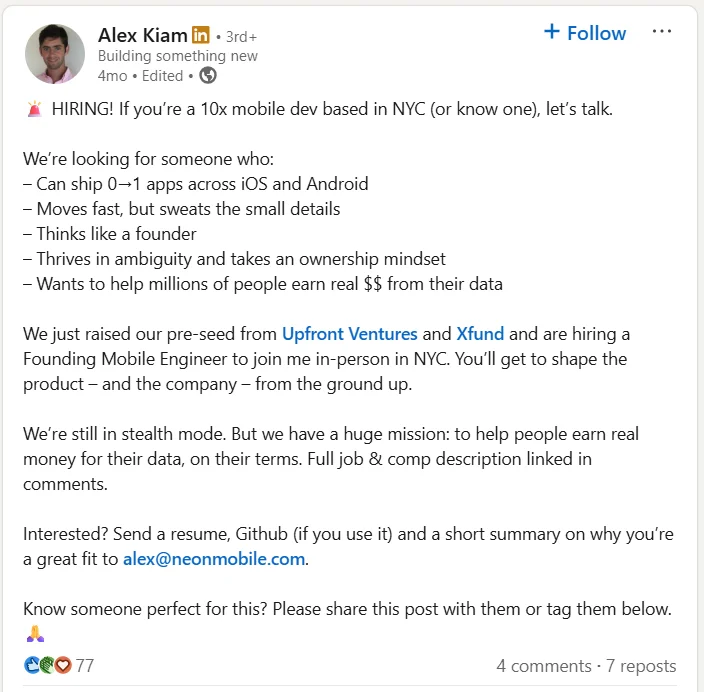
A LinkedIn post indicates a founder named Kiam raised money from Upfront Ventures a few months ago for his startup, but the investor didn’t respond to an inquiry. As the Neon app pays for calls and gains more users, it highlights a growing trend of users trading significant privacy for potential earnings, blurring the lines between data rights, ethics and the law.
What is the Neon app?
Neon is a mobile app that pays users up to 30 cents per minute to record their phone conversations, which it then sells as data to AI companies.
Is the Neon app safe?
Privacy experts have raised concerns that the voice data collected by Neon could be used for impersonation or advanced scams, as the company does not disclose who its AI partners are.
How does the Neon app make money?
Neon’s business model is based on selling the voice recordings it collects from users to third-party companies, including those working on AI voice synthesis.