
AMD Strix Halo vs Apple Mac Studio is the defining local AI hardware question of 2026, and the answer changed on August 25 when Apple replaced the M4 Max and M3 Ultra with the M5 Max and M5 Ultra. Local inference is no longer a question of whether you have enough GPU VRAM. It is a question of memory bandwidth, how much of your unified pool the driver will actually let you address, and whether your software stack runs where you need it to.
Short answer: the AMD Ryzen AI Max+ 395 is the cheapest way to fit a large model in memory on an x86 Linux box, and it is roughly three to five times slower at generating tokens than an M5 Mac Studio. Buy AMD when capacity per dollar and Linux control matter most. Buy Apple when tokens per second is what you are actually paying for.
What Changed in 2026
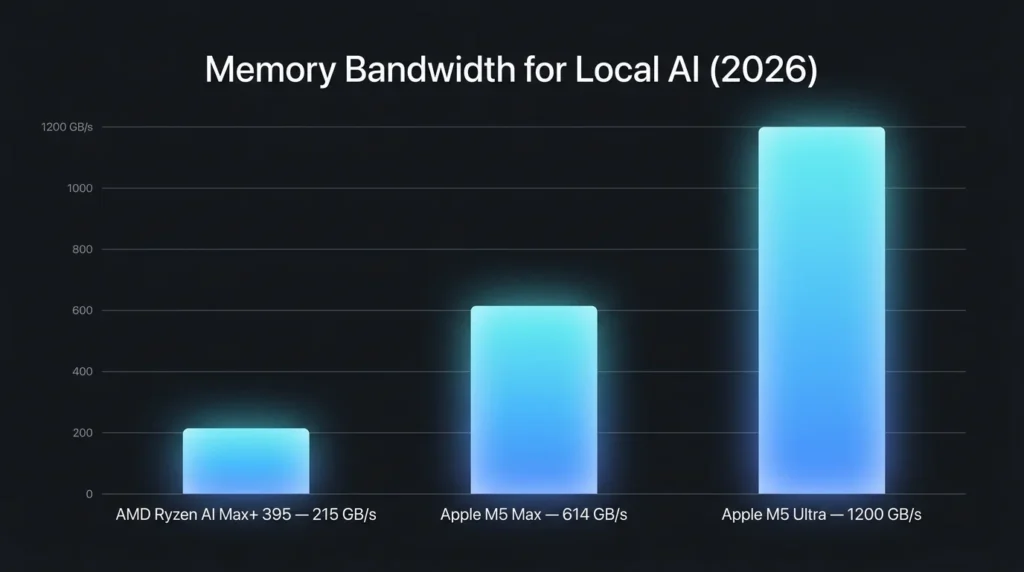
Two things reset this comparison. Apple announced the M5 Max and M5 Ultra Mac Studio on August 25, 2026, with machines shipping from September 22 and the 512GB configuration following in late October. The M5 Ultra pushes memory bandwidth to 1.2TB/s, a 50 percent increase over the M3 Ultra it replaces.
On the AMD side, CES 2026 brought the Ryzen AI Max+ 392 and 388, which give the full 40-CU integrated GPU to lower core-count parts alongside faster LPDDR5X-8533 memory. The flagship 395 itself is unchanged, and no direct successor has been announced. If you want a 128GB unified memory x86 box today, there is no strong reason to wait.
The third factor affects both camps: the global memory shortage has pushed pricing up across the entire category, and it is the reason Apple’s largest configuration ships a month behind the rest of the line.
The 2026 Specification Comparison
| Feature | Ryzen AI Max+ 395 | Mac Studio M5 Max | Mac Studio M5 Ultra |
| Memory bandwidth | 256 GB/s theoretical, ~215 GB/s measured | 460 GB/s base, 614 GB/s with 40-core GPU | 1.2 TB/s |
| Max unified memory | 128 GB LPDDR5X-8000 | 128 GB (40-core GPU config only) | 512 GB (36-core CPU config only) |
| Usable for model weights | ~96 GB Windows, ~108 GB Linux | ~75% of pool by default | ~75% of pool by default |
| CPU | 16 Zen 5 cores | 18-core | 30-core, up to 36-core |
| GPU | 40 RDNA 3.5 compute units (Radeon 8060S) | 32-core, up to 40-core | 64-core, up to 80-core |
| NPU | XDNA 2, ~50 TOPS INT8 | 16-core Neural Engine | 32-core Neural Engine |
| Software stack | Linux, Windows, ROCm | macOS, MLX, Metal | macOS, MLX, Metal |
| Starting price | ~$2,000 and up, shortage dependent | $2,499 | $5,499 |
Note the AMD row carefully. Forty RDNA 3.5 compute units is not the same unit of measurement as forty Apple GPU cores, and most comparison tables that place those numbers side by side imply a parity that does not exist. The CU count tells you the shape of the silicon, not its throughput relative to a different architecture.
Note the Apple rows too. The widely quoted 614GB/s figure for the M5 Max applies only to the upgraded 40-core GPU configuration, which is also the only M5 Max that supports 128GB. The base machine runs at 460GB/s. We broke down every configuration tier in our M5 Max vs M5 Ultra buying guide.
Theoretical Bandwidth vs What You Measure
Strix Halo’s 256GB/s comes from a 256-bit LPDDR5X-8000 bus. That is the theoretical peak. Independent testing consistently lands around 212 to 215GB/s under mixed CPU and GPU load, a gap of roughly 16 percent that is typical for LPDDR5X.
Use the measured number when you plan, because token generation is bound by real throughput, not by the number on the spec sheet. A rough ceiling for decode speed is available bandwidth divided by the size of the active weights.
| 70B dense model at Q4 (~40GB weights) | Theoretical decode ceiling |
| Ryzen AI Max+ 395 at 215 GB/s | ~5 tokens/sec |
| M5 Max at 614 GB/s | ~15 tokens/sec |
| M5 Ultra at 1.2 TB/s | ~30 tokens/sec |
Published estimates for Llama 3.3 70B on Strix Halo cluster around 2.4 to 5.1 tokens per second, which lines up closely with the calculation above. That is the honest picture: the model loads, and it loads slowly.
How Much Memory Can You Actually Use?
This is the question most comparisons skip, and it matters more than the headline capacity on both platforms.
- Strix Halo: up to 96GB of the 128GB pool can be assigned to the GPU through AMD Variable Graphics Memory on Windows or GTT on Linux, leaving the balance for the OS. Under Linux with a recent kernel you can push past the stock BIOS cap, with reports of roughly 108GB or more exposed to the GPU. Linux is not just a preference here, it is a measurable capacity advantage.
- Mac Studio: macOS reserves a slice of unified memory for the system through its wired memory limit. Plan around roughly three quarters of the pool being addressable for weights and KV cache unless you raise that limit manually.
Both platforms therefore deliver less usable model space than the box says. Budget for it before you order, because on both machines the memory is soldered and the configuration you buy is the configuration you keep.
Prefill vs Decode: Where Each Platform Wins
Inference splits into two phases with different bottlenecks, and treating them as one number is why so many buying guides give bad advice.
- Prefill, or prompt processing, is compute-bound. This is long-context work, large RAG payloads, and agentic loops that resend big prompts on every turn. Strix Halo is weakest here, and it is the phase most likely to make the machine feel sluggish in real development work.
- Decode, or token generation, is memory-bound. Every token requires streaming the active weights across the bus. This is where Apple’s bandwidth advantage converts directly into perceived speed.
Mixture-of-experts models change the balance considerably. An MoE model activates only a fraction of its parameters per token, so it moves far less data per token than a dense model of comparable size. That is why GPT-OSS 120B runs around 34 tokens per second on Strix Halo while a dense 70B crawls. If your workflow is MoE-first, the AMD platform punches well above its bandwidth.
Software: ROCm vs MLX, Without the Marketing
- Apple (MLX and Metal): MLX is built specifically around the unified memory model, and Apple-optimized quantizations now appear alongside standard releases within days of a model launch. The experience is close to frictionless, and it is closed.
- AMD (ROCm and Linux): ROCm has improved substantially and standard PyTorch and vLLM inference paths are reliable. Calling it CUDA parity is still an overstatement. Decode performance is competitive; prefill and prompt processing is where the gap remains visible, and niche kernels still need work.
Both platforms run llama.cpp well, which remains the pragmatic choice if you want one toolchain across a Mac and a Linux box. LM Studio and Ollama cover the desktop workflow on both.
Real Pricing in a Shortage Year
The M5 Max Mac Studio starts at $2,499 and the M5 Ultra at $5,499. Those already reflect a broad price increase Apple applied in June 2026, which raised the Mac Studio entry point by $500. A 512GB Ultra with meaningful storage clears $10,000.
Strix Halo machines launched around $1,999 for the 128GB configuration in platforms like the Framework Desktop, the GMKtec EVO-X2 and the HP Z2 Mini G1a. The memory shortage has pushed street pricing well past that figure, so treat any 2025 price you find in older articles as historical.
The value comparison that still holds: for roughly the price of a base M5 Max, you can have a 128GB AMD box. For roughly the price of a base M5 Ultra, you can have two of them.
What About NVIDIA?
Any honest 2026 comparison has to address the third option. The NVIDIA DGX Spark pairs 128GB of coherent unified memory with roughly 273GB/s of bandwidth and about 1 petaflop of FP4 compute, in a 170W chassis running an Ubuntu-based DGX OS. It launched at $3,999 and rose to $4,699 in February 2026, again because of memory supply.
On bandwidth it sits just above Strix Halo and well below any M5 Mac Studio, and reported throughput reflects that, with GPT-OSS 120B measured around 38.6 tokens per second. What you are actually buying is native CUDA compatibility, which for teams whose production stack is CUDA is worth more than the raw numbers suggest.
The RTX 5090 remains the correct answer for anything that fits in 32GB. At roughly 1,792GB/s it is several times faster than every unified memory platform here. The moment your model exceeds its VRAM, it falls off a cliff, and that cliff is the entire reason this category exists.
Power and Thermals
A common claim is that the x86 platform is the power-hungry option. The numbers do not support it in absolute terms. Strix Halo runs a configurable 45W to 120W TDP with a 55W default. Apple lists maximum continuous power for the Mac Studio at 480W.
The fair claim is performance per watt, where Apple leads clearly, since it delivers several times the token throughput for its power draw. If you are running overnight batch jobs somewhere with expensive or unreliable electricity, model both the consumption and the cooling before choosing.
Final Verdict: Which Should You Buy?
- Choose the Ryzen AI Max+ 395 if: you need Linux-native tooling, container workflows and hardware you control end to end, you work primarily with MoE models, and capacity per dollar matters more than tokens per second. It is the cheapest legitimate path into 128GB-class local inference.
- Choose the M5 Max with 40-core GPU and 128GB if: you want the best balance in the category. It matches AMD on capacity, roughly triples it on usable bandwidth, and it is the configuration most developers should default to.
- Choose the M5 Ultra if: you are bandwidth-bound on dense models, or you need 256GB to 512GB to hold frontier-scale weights in memory. Nothing else in this price class comes close on throughput.
- Choose the DGX Spark if: CUDA parity with your production environment is non-negotiable and you are prototyping rather than serving.
The framing that has held up best through 2026 is this: AMD wins by fitting the model, Apple wins by running it fast, and NVIDIA wins by matching the stack you already deploy on. Decide which of those three constraints is actually blocking your work, and the hardware choice follows.
Can the Ryzen AI Max+ 395 really use all 128GB for models?
No. Up to 96GB can be assigned to the GPU through AMD Variable Graphics Memory on Windows or GTT on Linux. Under Linux with a recent kernel you can push beyond the stock cap, with roughly 108GB or more reported. The remainder stays with the operating system.
Is 128GB unified memory enough for 100B-plus parameter models?
For mixture-of-experts models, yes. A 120B-class MoE at Q4 occupies roughly 65GB of weights and runs at usable speed, around 34 tokens per second on Strix Halo. Dense models of similar size are a different story, since they stream far more data per token.
Is ROCm CUDA-ready in 2026?
Close for standard workflows, not identical. PyTorch and vLLM inference paths are reliable, and decode performance is competitive. Prompt processing still trails, and niche custom kernels may need porting work. Treat claims of full parity with caution.
Does the AMD platform use more power than a Mac Studio?
In absolute terms, no. Strix Halo runs a configurable 45W to 120W TDP, while Apple lists maximum continuous power for the Mac Studio at 480W. Apple wins decisively on performance per watt, which is the more useful measure.
Should I wait for a Strix Halo successor?
There is no announced successor to the Ryzen AI Max+ 395. CES 2026 added the Max+ 392 and 388, which bring the full 40-CU integrated GPU to lower core-count parts with faster memory, but the flagship is unchanged. There is no strong reason to delay a purchase.
Apple specifications verified against the official Mac Studio technical specifications and the August 25, 2026 Apple Newsroom announcement. AMD figures reflect independent testing of shipping Ryzen AI Max+ 395 platforms. Decode ceilings are calculated from published bandwidth figures and are not first-party benchmarks. Last updated September 4, 2026.